

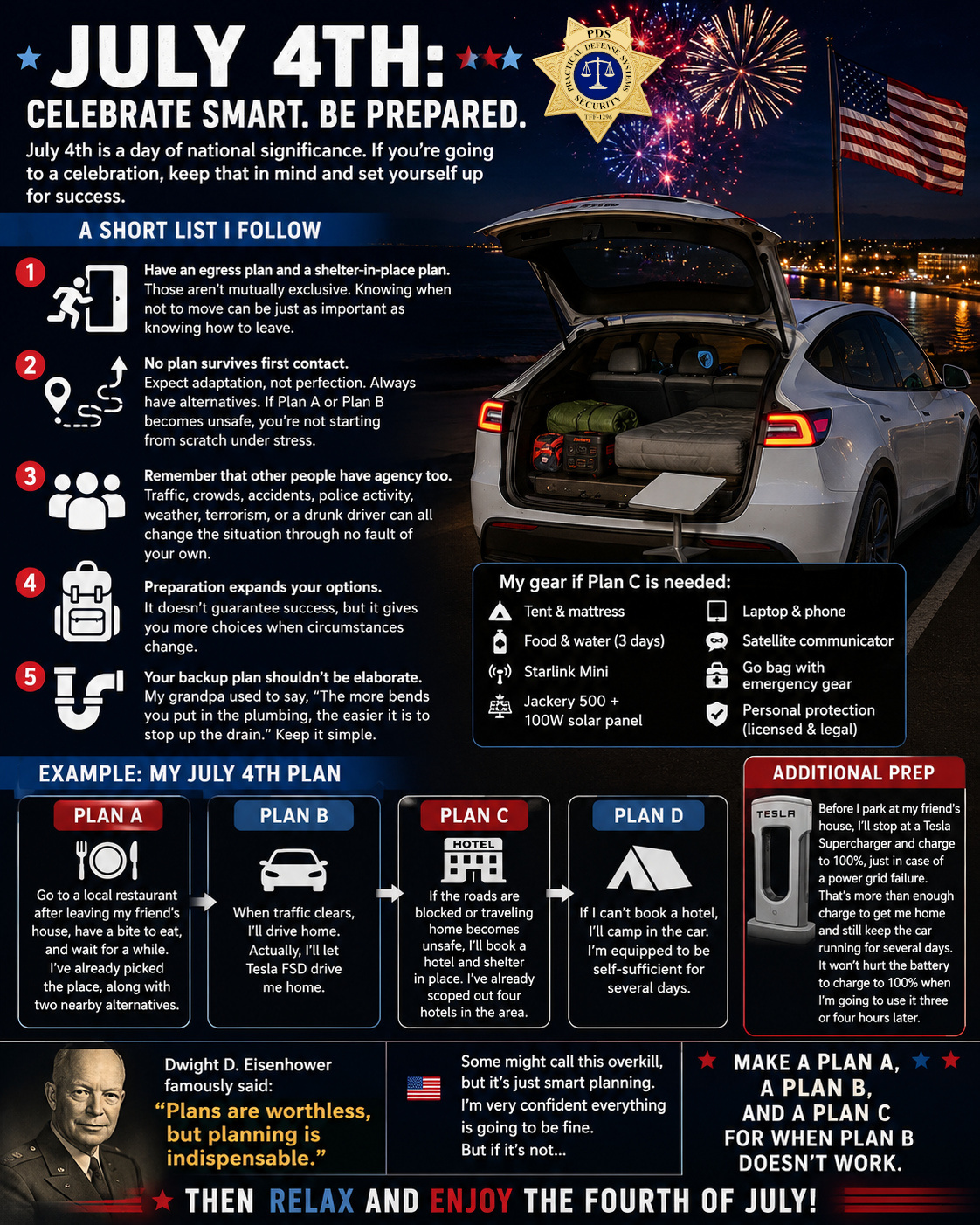
July 4th is a day of national significance. If you're going to a celebration, keep that in mind and set yourself up for success.
Here's a short list I follow (I made a graphic for you to make it easier):
1. Have an egress plan and a shelter-in-place plan. Those aren't mutually exclusive. Knowing when not to move can be just as important as knowing how to leave.
2. No plan survives first contact. Expect adaptation, not perfection. Always have alternatives. If Plan A or Plan B becomes unsafe, you're not starting from scratch under stress.
3. Remember that other people have agency too. Traffic, crowds, accidents, police activity, weather, terrorism, or a drunk driver can all change the situation through no fault of your own.
4. Preparation expands your options. It doesn't guarantee success, but it gives you more choices when circumstances change.
5. Your backup plan shouldn't be elaborate. My grandpa used to say, "The more bends you put in the plumbing, the easier it is to stop up the drain." Keep it simple.
Here's an example.
I'm going to a buddy's house in Orange County for the Fourth. I plan to drive home after the fireworks, but traffic will be horrible. My plan:
1. Go to a local restaurant after leaving my friend's house, have a bite to eat, and wait for a while. I've already picked the place, along with two nearby alternatives.
2. When traffic clears, I'll drive home. Actually, I'll let Tesla FSD drive me home.
3. If the roads are blocked or traveling home becomes unsafe for some reason, I'll try to book a room at a local hotel and shelter in place. I've already scoped out four hotels in the area.
4. If I can't book a hotel room, I'll camp in the car. I have a tent, mattress, and camping gear specifically for my Model Y. I'll have food and water for three days, a Starlink Mini, a Jackery 500 with a 100W solar panel, a laptop, a phone, a satellite communicator, my go bag full of emergency gear, body armor, a pistol, and ammunition (I have a California CCW permit).
Additional prep: Before I park at my friend's house, I'll stop at a Tesla Supercharger and charge the car to 100%, just in case of a power grid failure. That's more than enough charge to get me home and still keep the car running for several days. It won't hurt the battery to charge it to 100% when I'm going to use it three or four hours later.
Some might call this overkill, but it's just smart planning. I'm very confident everything is going to be fine. But if it's not...
Dwight D. Eisenhower famously said:
"Plans are worthless, but planning is indispensable."
Make a Plan A, a Plan B, and a Plan C for when Plan B doesn't work.
Then relax and enjoy the Fourth of July!
See less
In the first half, attorney Sean Maloney from Second Call Defense joins me to explain the lessons gun owners can learn from what happened to Kyle Rittenhouse.
In the second half, I discuss a home invasion case from Oceanside California in which the homeowner successfully defended himself.